How to Fix a Chipped, Cracked, or Broken Front Tooth
How to Fix a Chipped, Cracked, or Broken Front Tooth

A damaged front tooth gets fixed one of four ways: smoothing the rough edge, rebuilding it with composite resin, covering it with a porcelain veneer, or capping it with a crown. Which one your tooth needs comes down to how much structure is gone and whether the inside of the tooth is involved. At Present Dental in Oklahoma City, OK, most chips turn out to be smaller than they feel in the moment, and a good share of them get handled the same day you walk in.
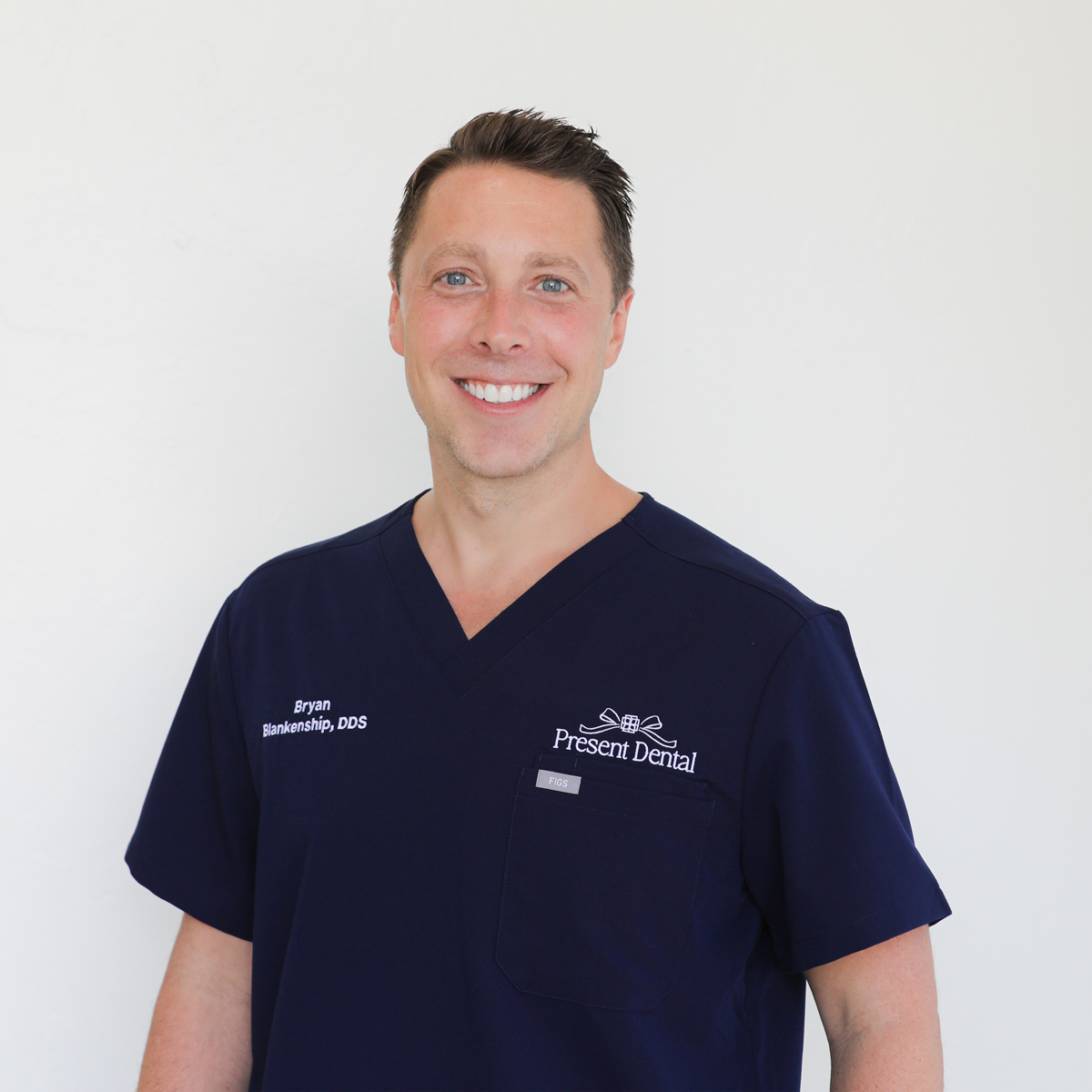
Dr. Bryan Blankenship sees this injury year round. A popcorn kernel during movie night, a fall off a scooter, an elbow to the mouth in a rec league game. The panic is almost always bigger than the damage, and the honest first answer is that a broken front tooth is one of the most fixable problems in dentistry.
This Article Will Address
- The repair options for a chipped or broken front tooth
- When the damage counts as an emergency and when it can wait
- What to do in the hours before your appointment
- How bonding and veneers compare for a single tooth
- Whether the repair finishes in one visit
- What the repair typically costs
How Do You Fix a Chipped Front Tooth?
Four repairs cover nearly every chipped front tooth, and your dentist chooses between them based on the size of the chip and what sits underneath it.
- Enameloplasty, which means smoothing and polishing the rough edge. Right for nicks the size of a fingernail catch, with no numbing and no recovery.
- Composite bonding, where tooth colored resin is shaped onto the tooth and hardened with a curing light. This handles most small and moderate chips on front teeth.
- Porcelain veneer, a thin shell that covers the entire front surface. A strong fit when the chip is large, the edge is worn down, or the tooth is discolored as well.
- Dental crown, full coverage for a tooth that has lost real structure or already carries a large filling holding it together.
Front teeth carry a challenge molars do not. Enamel along the biting edge of an incisor is slightly see through, so a repair that is structurally perfect can still read as flat or chalky if the shade work gets rushed. Our cosmetic dentistry work leans on an intraoral scanner instead of impression trays and on layering composite in stages to hold that translucency. That is the difference between a repair nobody notices and one you see every time you pass a mirror.
Is a Chipped or Cracked Tooth a Dental Emergency?
Most chips are not emergencies, but some are. The dividing line is whether the inner tissue is exposed or the tooth hurts. Call the office the same day if any of these apply:
- You can see pink or red tissue inside the tooth
- Pain is severe or throbbing, or cold water is unbearable
- Bleeding has not stopped after ten to fifteen minutes of steady pressure
- The tooth is loose, pushed out of position, or in pieces
- The injury came with a blow to the head, jaw, or face
A small chip with no pain is still an appointment, just not an urgent one. Enamel does not grow back, and an open edge gives bacteria a path toward the softer dentin underneath. Put it off for six months and a bonding appointment often turns into something larger.
What Should You Do Right After You Break a Front Tooth?
Rinse with warm water, save any pieces, and call us. Those three steps cover most of what you can do on your own. A few more details help:
- Rinse gently with warm water to clear debris out of the area
- Keep the broken fragment in milk or saliva, since it can sometimes be reattached
- Hold clean gauze against any bleeding for ten to fifteen minutes
- Press a cold compress to the lip or cheek to hold swelling down
- Cover a sharp edge with sugar free gum or dental wax so it stops cutting your tongue
- Do not place aspirin against the gum, which burns the soft tissue
Then call, even if it happened after hours. We hold room in the schedule for people who show up with a visible break, because nobody should spend three workdays talking with a hand in front of their mouth.
Should I Get Bonding or a Veneer for a Chipped Tooth?
Bonding is the better answer for one small or moderate chip. A veneer makes more sense when the tooth needs a full cosmetic reset.
Dental bonding finishes in a single appointment, usually without numbing, and adds material to the tooth without removing healthy enamel. It costs less, and if it chips again in a few years it gets patched instead of replaced. The tradeoff is that composite picks up stain from coffee and red wine over time and generally lasts five to ten years before it wants a touch up.
Porcelain veneers take two visits and require shaving a thin layer of enamel, which is permanent. In return you get a surface that resists stain and holds its color for a decade or more. Veneers tend to win when the damaged tooth is also discolored, worn short, or sitting beside teeth you want matched to it.
One detail worth hearing before you decide: matching a single veneer to the natural tooth next to it is demanding work, and sometimes the honest recommendation is to treat both so the pair reads as a set. Bonding rarely creates that question.
Can a Chipped Tooth Be Fixed in One Visit?
Often, yes. Smoothing and composite bonding both finish in a single appointment, usually thirty to sixty minutes per tooth, and you leave with the tooth already looking right.
Veneers and crowns are the exception, since both are fabricated outside the mouth. Those run two appointments a couple of weeks apart with a temporary in between. Our scanner replaces the putty impression at that first visit, which patients with a sensitive gag reflex appreciate more than any other piece of technology in the building.
A crack that reaches the nerve changes the timeline again. That tooth needs root canal therapy first and its dental crown after, because capping a tooth that is still going to ache solves nothing.
How Much Does It Cost to Fix a Chipped Tooth?
Nationally, chipped front tooth repair runs from roughly $100 for smoothing an edge to $1,000 or more for a crown. Bonding typically lands between $300 and $600 per tooth, and veneers between $900 and $2,500. Those are national ranges rather than our fees, and the only figure that matters is the one attached to your tooth after an exam.
Insurance follows a more predictable logic than most people expect. Work classified as restorative, meaning the tooth lost structure and needs it rebuilt, usually draws partial coverage. Work classified as purely cosmetic usually does not. A crown on a tooth you fractured on a peach pit is often covered in part. A veneer on an intact tooth you simply want reshaped is often not.
Because our general and cosmetic dental services sit under one roof, a chip that turns out to need a root canal does not send you across town to a second office and a second treatment plan. We go through your coverage before anything gets scheduled, since finding out afterward is a rough way to start with a new dentist.
Book Your Chipped Front Tooth Repair at Present Dental
We are open Monday through Friday, welcoming new patients, and happy to take a look at a broken tooth this week rather than next month. Dr. Blankenship will tell you plainly what the tooth needs and what it will take to get there. Call our Oklahoma City office at (405) 946-6136 or request an appointment and we will find you a time.
Sources
Meet Dr. Blankenship
Dr. Bryan M. Blankenship’s roots in Oklahoma City run through his military service in the Oklahoma Army National Guard. His calling to dentistry took hold during his deployment to Baghdad, and he came home knowing what he wanted to do with the rest of his career.
He graduated from the University of Central Oklahoma in 2010 with a bachelor’s degree in biology, then earned his Doctorate of Dental Surgery from the University of Oklahoma College of Dentistry in 2016.
Rather than head straight into practice, he stayed on at the University of Oklahoma for a one-year residency in Advanced Education in General Dentistry, training specifically in dental implants, cosmetic dentistry, and a range of other restorative procedures. That extra year matters for patients. Implant placement and full-mouth restorative work are cases many general dentists refer out, so his patients can often finish treatment in one office with a dentist who already knows their history.
Outside the practice, family comes first. His wife, Christy, is also a dental professional, and together they’re raising their two children, Bailey and Beau. You’ll find the family at Thunder games during the season, traveling somewhere new when they get the chance, or out fishing whenever Oklahoma weather cooperates.